

Visualisation of forbidden polar order in ferroelectrics
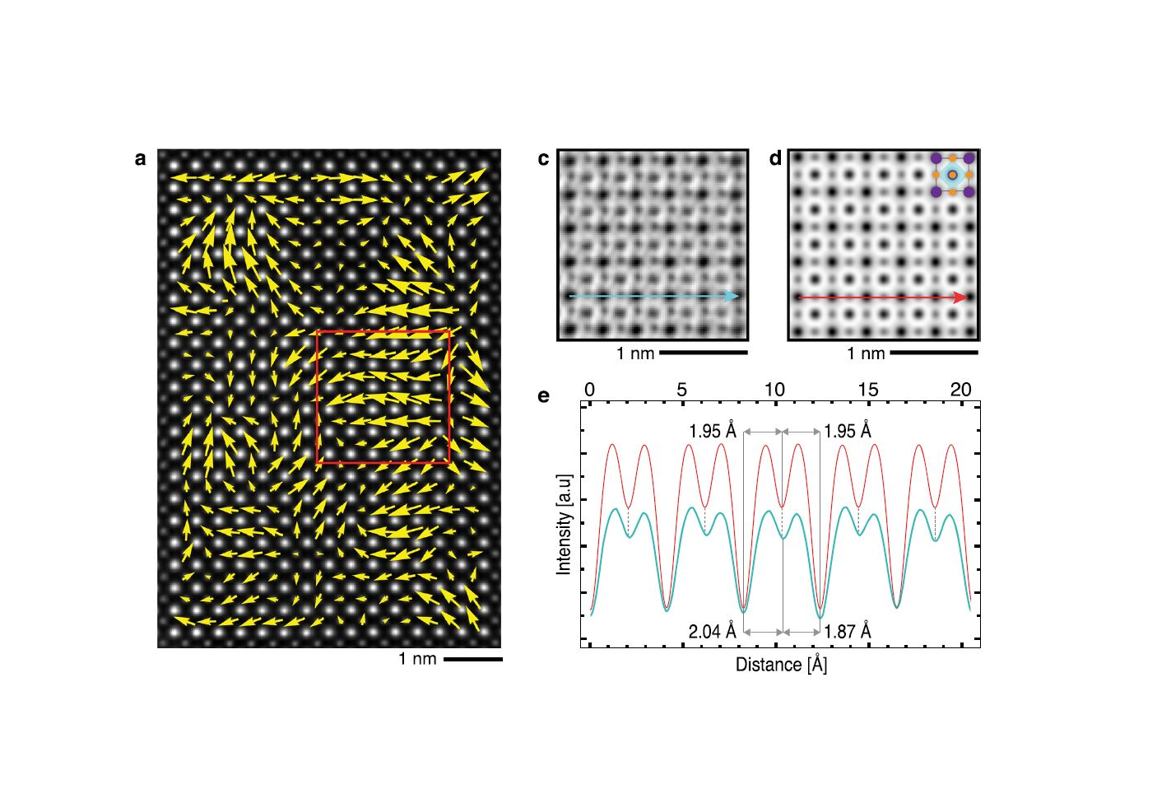
The hypothetical presence of polar nanoscale objects in the paraelectric phase of perovskite ferroelectrics has been discussed for decades and up to now has never been experimentally proven.
Using scanning transmission electron microscopy combining with Raman spectroscopy the authors from Jozef Stefan institute, National Institute of Chemistry, Ecole Polytechnique Federal de Lausanne, Materials Centre Leoben and Tokyo Institute of Technology provided direct atomic-scale evidence and structural details of static, 2–4 nm large polar nanoclusters in centrosymmetric phase of Ba,SrTiO3 and BaTiO3 ferroelectrics. In contrast to previous thinking, this study shows that the direction of polarization within a given polar nanocluster is stable on the time scale of measurements (tens to hundreds of seconds). The probable reason for the stabilization is the presence of local strains, which originate from the size difference between additives, impurities, vacancies and host ions. The study was published in Nature Communications.
The identification of polar nanoclusters, their size, spatial distribution and properties, which are presented in the work could have an impact on modelling dielectric tunability and high frequency losses in this family of materials which are widely used in capacitors and microwave communications.
Link: https://www.nature.com/articles/s41467-021-23600-3
For more information please contact: goran.drazic[at]ki.si