

Inclusion of excited states in photocatalytic N2 reduction
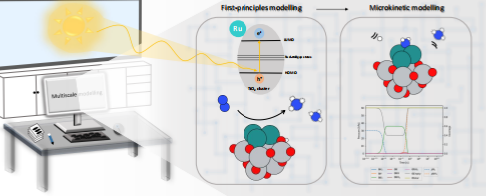
The Haber-Bosch process is the predominant industrial route for ammonia synthesis, yet its notable environmental impact has driven the search for greener nitrogen activation methods. Photocatalytic nitrogen reduction is an environmentally friendly alternative, enabling ammonia synthesis under mild conditions using light. Despite the large number of experimental studies, theoretical research remains limited, with the studies investigating the reaction only at the ground state level. For an accurate description of photocatalytic processes, it is crucial to consider excited states.
Researchers from the Department of Catalysis and Chemical Reaction Engineering, Taja Žibert, Blaž Likozar and Matej Huš, have demonstrated the importance of accounting for excited states when modeling photocatalytic nitrogen reduction using quantum chemical calculations and microkinetic modelling.
Time-dependent density functional theory (TD-DFT) was employed to investigate the electronic properties of the Ru-TiO2 photocatalyst, the adsorption properties, and the nitrogen reduction mechanism in the ground and first excited states. To study the kinetics, the results derived from quantum chemical calculations were incorporated into a microkinetic model. Our results indicate that accounting for excited states lowers the activation barriers and increases the reaction rates. This study makes a significant contribution to theoretical research in the field of photocatalytic ammonia synthesis, where accounting for excited states is essential for an accurate description of the photocatalytic reaction mechanism and kinetics. In addition, this computational approach is applicable to other photocatalytic reactions. The study was published in the Small Structures (IF 11.3).
ONLINE LINK: https://onlinelibrary.wiley.com/doi/10.1002/sstr.202500221
CONTACT PERSON: taja.zibert(at)ki.si