

Using Virtual Ultrasound to Better Understand Drug Delivery
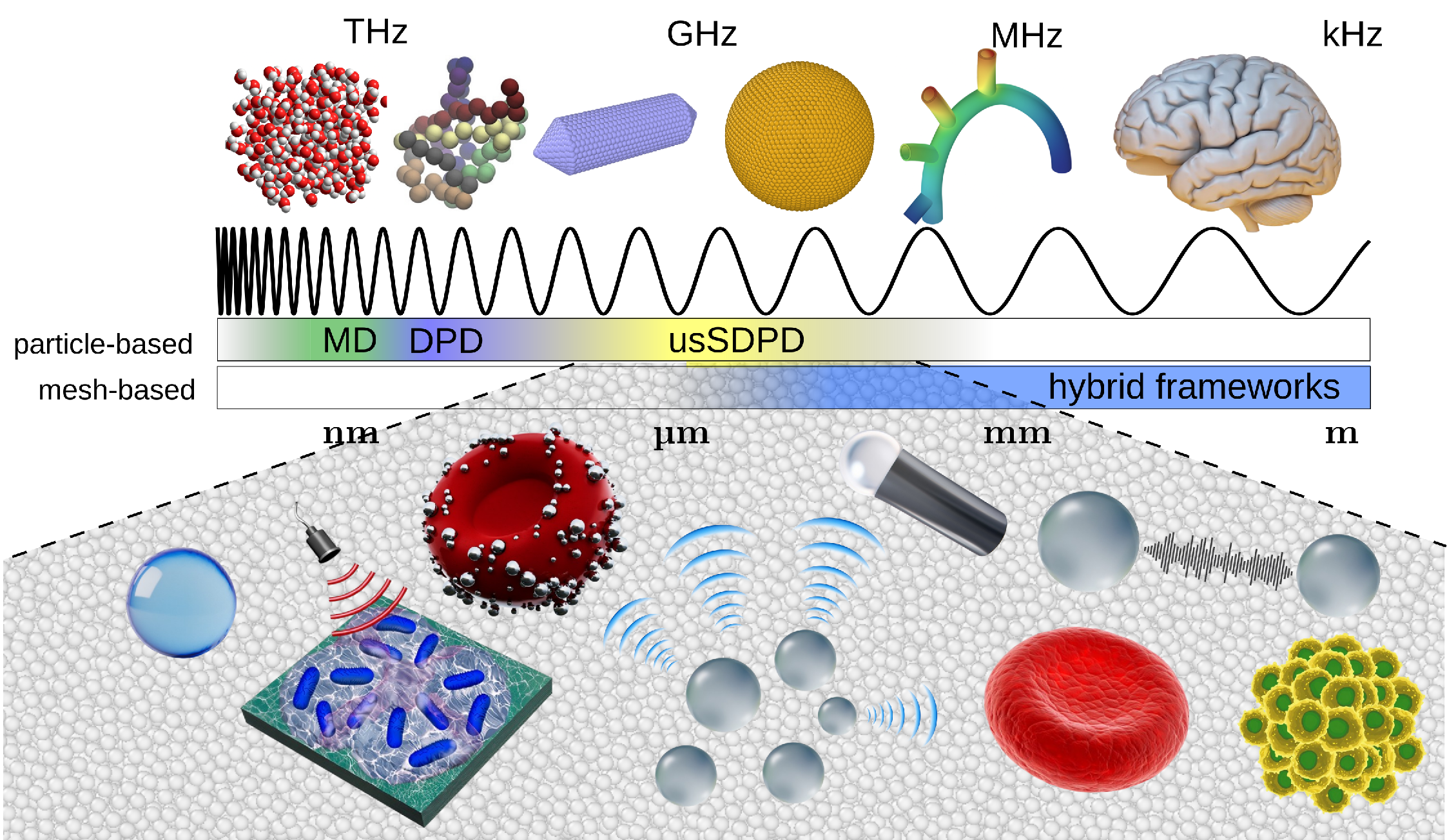
Ultrasound-guided drug and gene delivery, using encapsulated microbubbles, enables noninvasive, spatially precise treatment of diseases ranging from cancer to neurological disorders. However, current clinical protocols rely heavily on empirical tuning of acoustic parameters, limiting safety, reproducibility, and broader adoption.
Researchers from the Laboratory for Molecular Modeling at the National Institute of Chemistry have developed a particle-based virtual ultrasound machine, published in Proceedings of the National Academy of Sciences, capable of simulating medically relevant MHz wave propagation and its interaction with microbubbles at submicron resolution.
The method enables controlled, in silico modeling of ultrasound-based phenomena to advance ultrasound-guided drug and gene delivery across biomedical applications.
Article: https://www.pnas.org/doi/10.1073/pnas.2610567123
Contact: prof. dr. Matej Praprotnik