

ENZYME CATALYSIS IS PROBABLY DRIVEN BY ELECTROSTATICS: A COMPUTATIONAL INVESTIGATION
The project addresses perhaps the most important and fundamental open issue in biocatalysis, namely the origin of catalytic function of enzymes. While this principal function has been known to researchers for decades, the nature of the driving force behind it still represents a hotly debated topic. The views on this issue can be divided into two distinct hypotheses: (i) catalytic function of enzymes is ensured by preorganized electrostatics, and (ii) catalytic function of enzymes is ensured by dynamical effects. Both hypotheses have been investigated by a wide array of research techniques, but no consensus has been reached to date – among the rest due to the inability of experimental techniques to confirm or disprove either hypothesis – and any new insight would be vastly appreciated by the research community. Due to severe limitations of experimental techniques, theoretical and simulation methods appear to offer a viable platform to address the title problem.
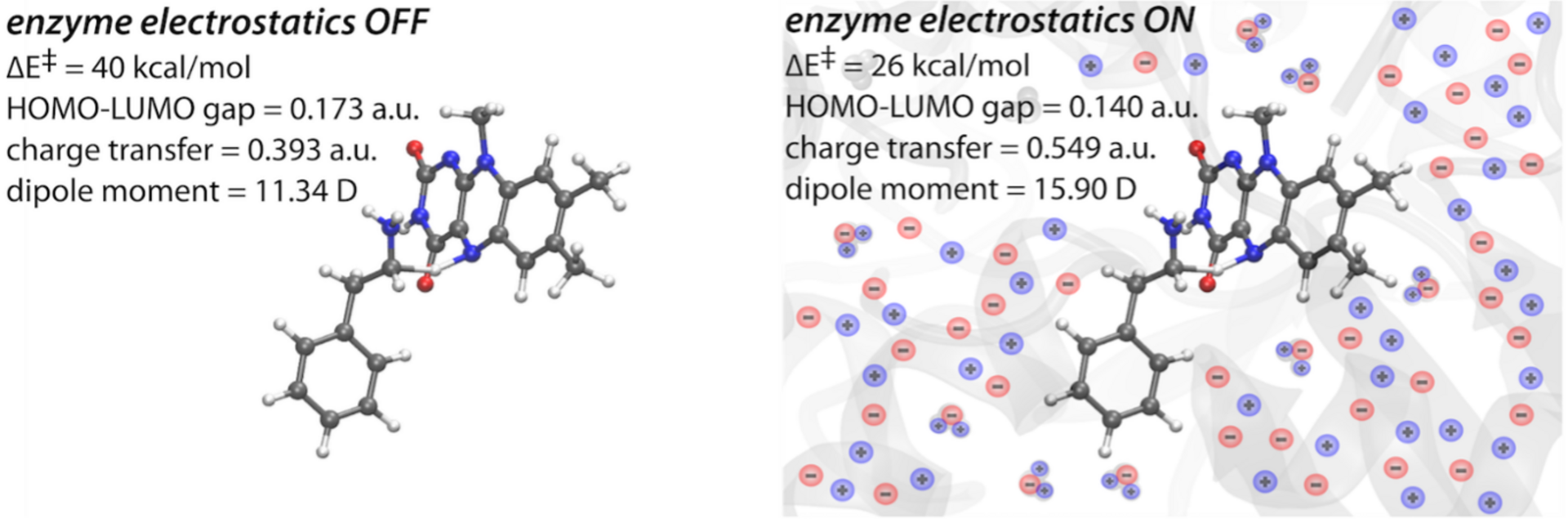
Our research group joined the debate by developing a simple and inexpensive but efficient computational approach facilitating insight into the role of electrostatics in enzymatic reactions [A. Prah et al., ACS Catal. 2019, 9, 1231-1240]. Using this approach, we demonstrated on the example of the monoamine oxidase A (MAO A) enzyme that electrostatic interactions substantially enhance the reaction by all the considered criteria. The magnitude of the effect suggests that the role of electrostatics in MAO A is not only significant, but rather essential far catalysis. Our findings are in full agreement with the hypothesis that enzyme catalysis derives from preorganized electrostatics.
The present project aims at devising proof-of-concept for the driving force behind enzyme catalysis, focusing on electrostatics as possible origin of catalysis. The role of electrostatic interactions is explored by extending our approach to as diverse as possible array of enzymes, their substrates and reaction mechanisms. Enzymes and their reactions subject to treatment are selected preferably among the cases in which the reaction mechanism is experimentally validated and reaction trajectories are available. In large part we rely on the recent studies of enzymatic reactions carried out by our group and collaborating groups experienced in the field of computational enzymology, and on our substantial experience in the modeling of enzymatic reactions by state-of-the-art multiscale simulation tools. We expect our research to provide links between the very limited experimental studies of electrostatics in enzyme active sites and the underlying theoretical concepts. In addition, important insights into the function of enzymes delivered by the proposed research will stimulate connection with experimental studies of enzymatic reactions (e.g., kinetic studies of point mutations) and facilitate the design of inhibitors as transition state analogs.
We expect that confirmation of substantial catalytic role of enzyme electrostatics on sufficiently large number of cases would lead to generalization and would represent a big step forward in validating not only the hypothesis of preorganized electrostatics, but also the transition state theory in enzymatic reactions. On the other hand, failure to attribute the catalytic effect of several enzymes to electrostatics would contribute to refutation of the considered hypothesis. In any case, the proposed project will deliver new fundamental insights into enzyme catalysis and provide important contribution in the resolving of one of the most intriguing issues of enzymology.
FUNDING
The reserach project is funded by the Slovenian Reserach and Innovation Agency (ARIS) with 2187 annual hours of price class C for a period of 3 years.
Funding period: 1. 10. 2023 - 30. 9. 2026