

Diverse role of lipids in protein nanopore structure
[Translate to English:]
A significant portion of the mammalian proteome is associated with lipid membranes, and many membrane proteins are valuable drug targets. The structure and function of membrane proteins depend on their interactions with lipids that constitute membranes. Actinoporins are α-pore-forming proteins that bind preferentially to sphingomyelin-containing membranes, where they oligomerize and form transmembrane pores.
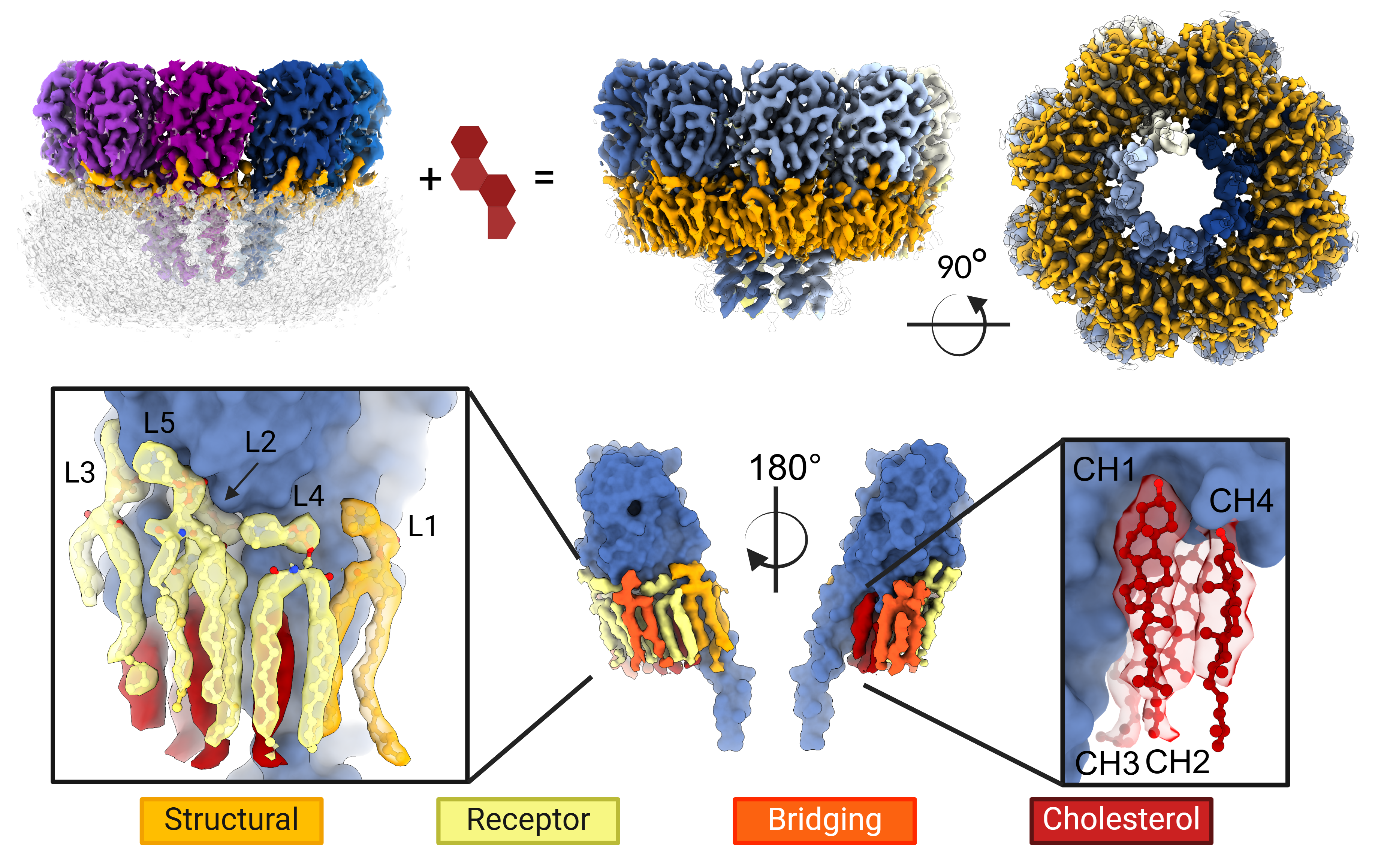
In this paper, we present a comprehensive cryo-electron microscopic analysis of a pore formed by an actinoporin homologue Fav, from the coral Orbicella faveolata. We show that the octameric pore interacts with 112 lipids in the upper leaflet of the membrane and reveal multiple roles lipids play in the pore structure, and demonstrate that the surface of Fav is suitable for binding multiple receptor sphingomyelin molecules. When cholesterol is present in the membrane, it forms a cluster of four molecules associated with each protomer. We complemented the structural data with atomistic simulations that reveal additional effects of the pore on the lipid membrane.
Our findings reveal a complex network of protein-lipid and lipid-lipid interactions and highlight an often underrated role of lipids in the structure and function of transmembrane protein complexes.
More: https://www.nature.com/articles/s41467-025-58334-z
Contact: gasper.solinc(at)ki.si