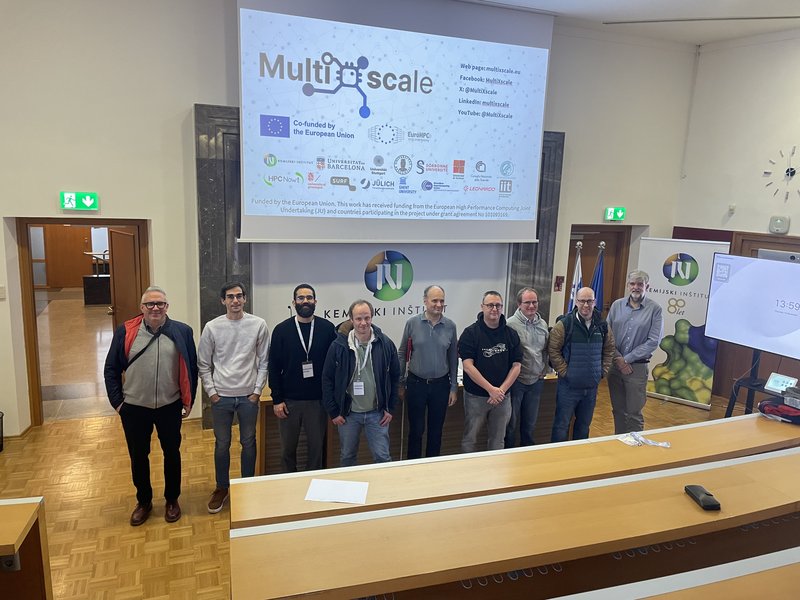
MultiXscale General Assembly Meeting and Workshop successfully organized in Ljubljana (Slovenia), 19-20 November 2026
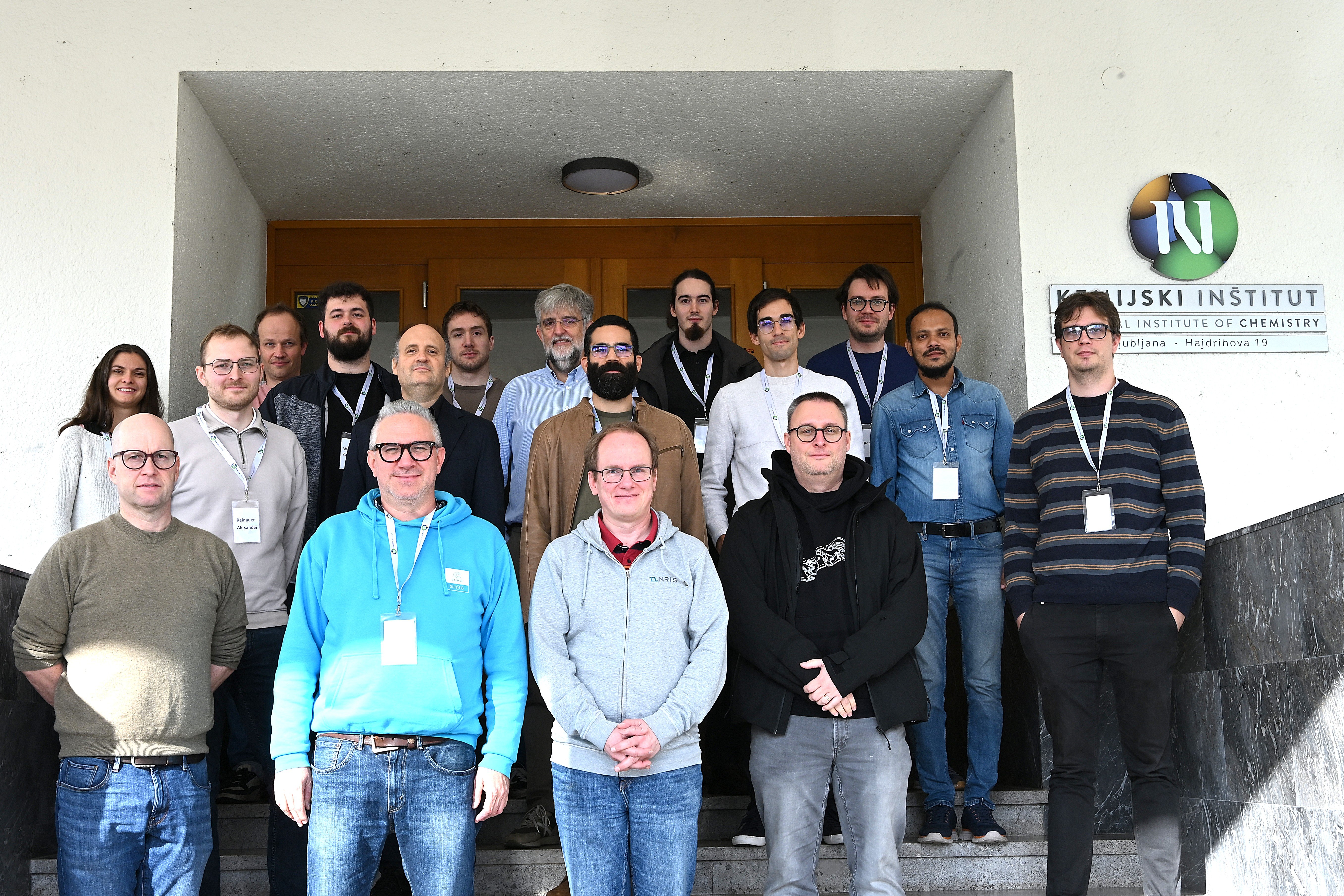
The MultiXscale General Assembly Meeting and Workshop were successfully organized at the National Institute of Chemistry in Ljubljana (Slovenia), on 19–20 November 2026.
The General Assembly brought together project partners to review the progress achieved throughout the project and discuss the final steps ahead of its completion in December 2026. It provided an excellent opportunity to combine project coordination, scientific exchange and practical knowledge sharing.
Alongside the General Assembly, the MultiXscale workshop on energy materials and sustainability, a CECAM-SISSA-SLING-SNS node event, focused on the role of multiscale modelling, computational methods and experimental research in advancing energy storage technologies. Participants had the opportunity to take part in a hands-on session about the European Environment for Scientific Software Installations (EESSI), that addressed one of the key challenges in scientific computing: building and porting software across different system architectures, including package installation and the management of complex dependencies. EESSI tackles these challenges by providing a shared software stack of scientific applications that runs across a wide range of computing environments, including HPC systems and cloud infrastructures. Supporting numerous CPU and GPU architectures, it offers researchers a consistent software environment and user experience, regardless of the underlying system.
The workshop also included a guided tour to the Center for Development, Demonstration and Training for Carbon-Free Technologies, to explore its research infrastructure dedicated to battery and hydrogen technology development. The center aims to strengthen collaboration between academia and industry, supporting the development of new materials, concepts, methods, standards and strategies for a wide range of battery applications. Beyond research, it also serves as a demonstration and training hub, bringing battery and hydrogen technologies closer to end users by showcasing their usability, durability and potential to reduce carbon footprints. Its new infrastructure will further support innovative learning approaches and provide training and reskilling opportunities at different educational levels, helping prepare the workforce for the adoption and practical application of green technologies.