

Who, if not the scientists, will develop medicines and vaccines?
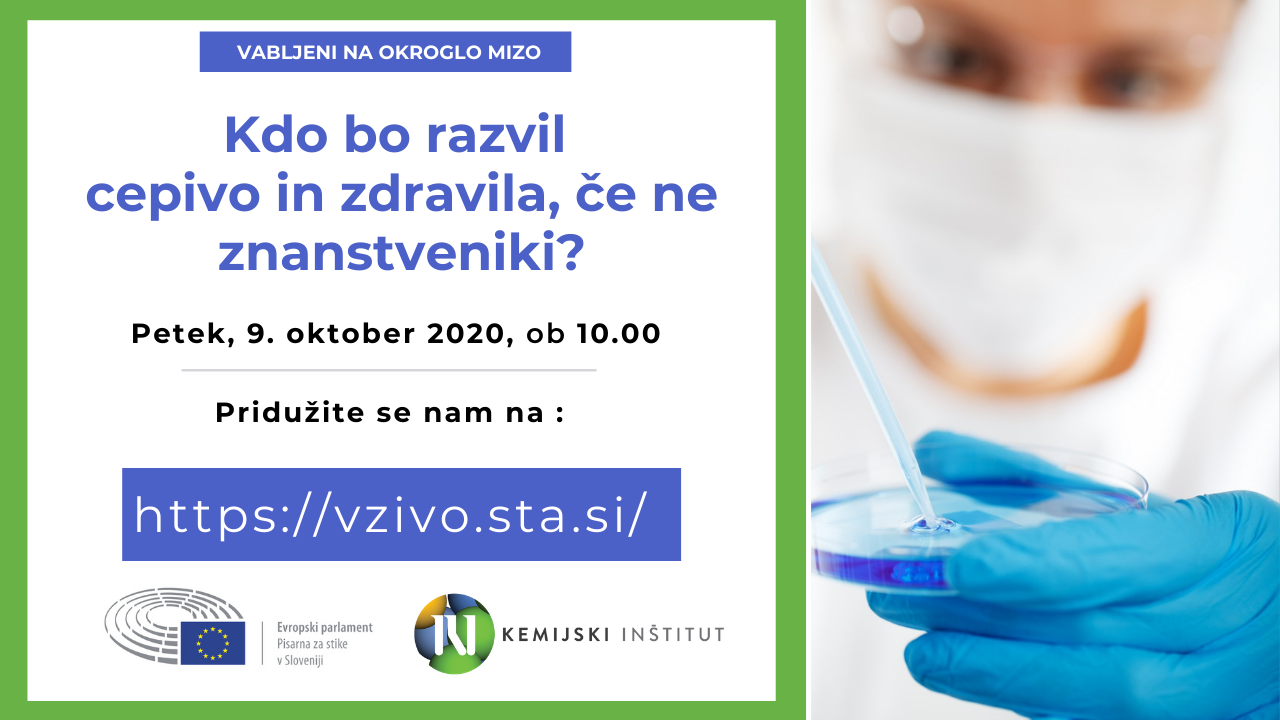
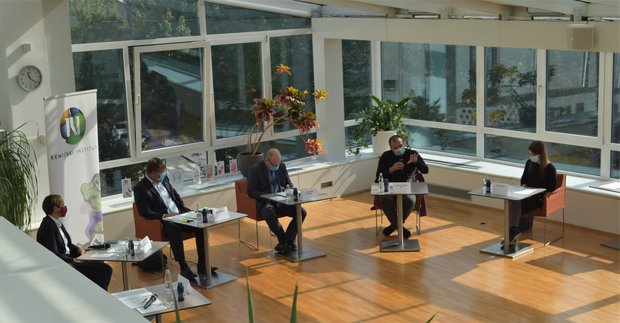
Ljubljana, 9 October 2020 - Investments in top science bring numerous benefits to society as a whole in the long run. Therefore, a national consensus is required to ensure adequate public finance support for science, which will enable a technological breakthrough for Slovenia in the next decade. These are the central messages from today’s round table, “Who, if not the scientists, will develop medicines and vaccines?”, organised by the European Parliament Liaison Office in Slovenia and the National Institute of Chemistry, at the latter’s premises in Ljubljana.
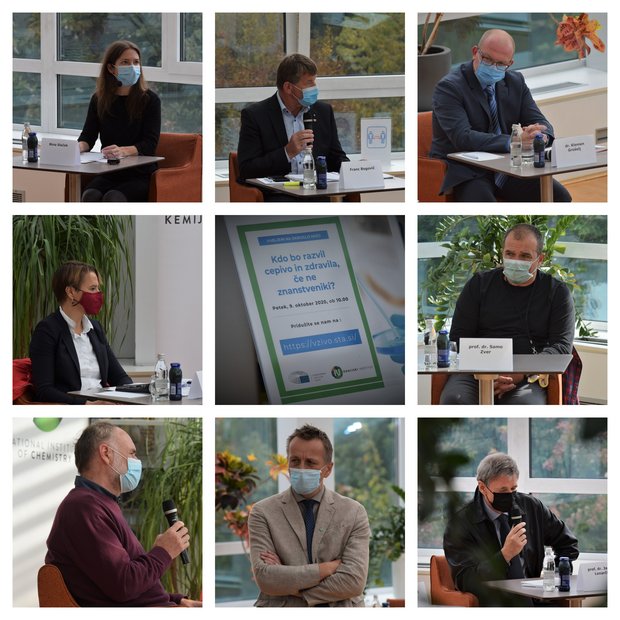
The round table was divided into two sets; the participants of the first, entitled “Why cuts in science, when we need it most?”, were MEPs Franc Bogovič (EPP) and Dr. Klemen Grošelj (Renew), State Secretary at the Ministry of Health, Dr. Tina Bregant, Director of the National Institute of Chemistry, Prof. Dr. Gregor Anderluh, and Director of the Jožef Stefan Institute, Prof. Dr. Jadran Lenarčič.
Participants of the second part, on the topic of “Excellent science and clinical medicine for advanced treatment methods”, in addition to MEPs Bogovič and Dr. Grošelj and State Secretary Dr. Bregant, were Prof. Dr. Roman Jerala, Head of the Department of Synthesis Biology and Immunology at the Chemical Institute, and Prof. Dr. Samo Zver, Head of the Clinical Department of Haematology at the University Medical Centre Ljubljana.
In the introduction, MEP Franc Bogovič (EPP) pointed out that the negotiations between the European Parliament and EU Member States on the scope of funding within the framework of the next multi-annual EU budget and the recovery fund, were still in progress. While the current proposal for 2021-2027 envisages EUR 80 billion for the EU’s core research programme, Horizon Europe, the European Parliament is calling for an increase to EUR 120 billion: “I expect the amount to be higher in the end, but I am not optimistic that we will reach 120 billion euros.” He also explained that Horizon is the largest public research programme in the world, and that funds from the EU budget will have to be added to the recovery fund, which could also be used for scientific projects, such as investments in scientific infrastructure. At the same time, he estimated that the ideology in Europe often makes it difficult to ensure that scientific achievements are applied in practice, which is the reason science is moving to other continents, which consequently reap the benefits of Europe’s efforts. MEP Bogovič also highlighted the need for greater EU resilience, especially in the manufacture of medical and protective equipment, as the covid-19 pandemic has exposed the EU’s dependence on third-country manufacturers, in particular China.
According to MEP Dr. Klemen Grošelj (Renew), the starting point for the European Parliament in budget negotiations was to ensure that all Member States have the levellest playing field possible, after emerging from the corona crisis. At the same time, it depends on the Member States themselves, whether they will use the available resources for a technological breakthrough or not. “European funds alone will not be sufficient, and they should be used to complement national investments in science and research. Today, Slovenia is in a position where European funds mean the survival of research,” he warned. Among other things, he called for the establishment of a technology agency, based on the Scandinavian model, which would also provide long-term financing for promising projects – especially in the field of basic research, which is not attractive for private sector investments due to high risk. “Considering that the funds from the recovery fund will have to be spent over the next five years, a national plan has to be drawn up to first secure national research funding, then to join the fund, thus improving competitiveness in obtaining Horizon funding in the last period of the next multi-annual financial framework,” pointed out Dr. Grošelj.
According to the State Secretary at the Ministry of Health, Dr. Tina Bregant, the government did cut funding for research in the revised budget, but research projects are included in some other areas, especially through projects of the Research Agency. She added that during the corona crisis, the government must act according to the triage system, and therefore give priority to the most critical areas, including the healthcare system in particular. From among the concrete proposals in this area, she mentioned the BARDA project of joint laboratories across Europe, which was also supported by the EU, and the common approach of the Member States to the development and procurement of a vaccine. The State Secretary added that the current crisis is also an opportunity to remodel values and establish cooperation practically at all levels. “It is both a quantitative and a qualitative leap. We need to shake off small-mindedness, since consensus and cooperation are essential,” she added.
Director of the National Institute of Chemistry, Prof. Dr. Gregor Anderluh, pointed out that in the future, the competition within the Horizon Europe programme will be much tougher, as in addition to funding basic research, the programme will also fund innovation. “Slovenia has so far received more than 300 million euros from the Horizon programme, but winning projects is very demanding, as it takes several years to establish the mechanisms and preparations,” he explained. He also drew attention to the Marie Curie Actions for the exchange of researchers, which is faced with a 200 million euro cut next year: “In the last few years, the share of foreign researchers in our country has increased to 15%.” Similarly, the budget of the European Research Council, the “jewel in the EU research crown”, is said to be at risk of cuts as well. Dr. Anderluh suggested that the Member States themselves would have to boost investment in order to reduce the decrease in funding at European level: “France and Estonia, for example, will do that, but the question is whether Slovenia will do the same,” he said.
According to the Director of the Jožef Stefan Institute, Prof. Dr. Jadran Lenarčič, Europe is the world pioneer in many scientific fields, such as the development of artificial intelligence, and information and communication technologies, but today it is practically an irrelevant player on a global scale, as it has been overtaken by competitors such as the USA and China. The situation in Slovenia is even worse than the EU average: “Slovenia has fallen behind by 30% in this area since 2011. We are facing a staff decline and an outdated infrastructure. In 2009, the ratio of investments in science per capita between Slovenia and Austria was 1:2, whereas today it is 1:7. In the last 10 years, Slovenia, alongside Hungary, has cut down the most research investment at the EU level, and has slid down the scale of innovation and technological development. We have talented staff who do not have the opportunity to pull the country forward, and we are increasingly hiring foreign experts instead of domestic ones,” criticised Dr. Lenarčič. As he added, a time of crisis is a time for action, otherwise “we will lose a whole generation of people”.
Prof. Dr. Roman Jerala, Head of the Department of Synthetic Biology and Immunology at the National Institute of Chemistry, gave an account of the current phase of covid-19 vaccine development. As he said, preclinical experiments on mice had been completed, and the following week they would be performed, in collaboration with the Faculty of Veterinary Medicine, on hamsters, which have a similar response to humans. “We solicited advice from the European Medicines Agency on the next steps to start clinical trials. This will require a lot of funding and cooperation,” he explained, pointing out that several scientific and medical institutions, as well as companies, are already involved in the project at the present stage. According to Dr. Jerala’s estimate, Europe could be even more active, not only in procuring the vaccine when it is available, but also in the development of vaccines. “It is important that Slovenia strives to tap the scientific and health potential for advanced therapies and vaccines in the treatment of other diseases, but a more active government policy will be needed,” said Dr. Jerala. He specifically referred to the idea of establishing a Centre for Advanced Therapies, which would combine biomedical research, universities, institutes, and clinics, in order to ensure a higher quality of treatment and therapies for complex diseases, such as genetic diseases: “This is the pillar of future medicine, namely modern methods are increasingly personalized and boutique, and Slovenia has potential in this area, but the support of the state will be needed, since this entails integration of basic research with clinical research.”
The idea of establishing the centre was strongly supported by Dr. Samo Zver, Head of the Clinical Department of Haematology at the University Medical Centre Ljubljana, who underlined additional advantages of such a centre, such as wider economic benefits (marketing of knowledge, development of biotech companies), and especially savings: “Preparations today cost several 100,000 euros, and we could provide at least 60% savings,” he explained. He is engaged in advanced cancer therapy, regarding which he mentioned a number of problems: “We do not have adequate equipment or facilities, and the Ministry of Health does not have time to meet with us. There is even no consensus on whether we need this.” At the same time, he warned of the long-term negative after-effects of the corona crisis on human health: “We have much fewer diagnostics and therapies, and there are also problems with staff shortages. Although we are in the middle of a crisis, we must devote attention to other diseases as well,” he emphasised.
Link: https://www.facebook.com/kemijskiinstitut/videos/42836781814785