

From Laboratory Cells to Efficient Zero-Gap Design
In developing the Slovenian Electrolyzer, we focus not only on catalysts but also on the design and operation of the entire electrolysis cell. Even highly active catalysts cannot reach their full potential when losses associated with electrical contacts, ionic transport or gas bubble formation are excessive.
Our development is based on zero-gap alkaline water electrolysis (AWE), in which porous nickel electrodes are positioned directly against the separator. This configuration reduces the ionic transport distance and enables a compact cell design.
Our engineering efforts so far have focused on:
- Cell geometry: reducing electrode spacing and implementing the zero-gap configuration.
- Electrical contacts: reducing contact resistance and improving electrical connections.
- Separator: developing our own thin, porous polymer-based separators.
- Electrolyte and gas transport: optimising flow fields, electrolyte distribution and gas bubble removal.
- Operating conditions: investigating temperature, KOH concentration and electrochemical electrode conditioning.
Through this approach, we have achieved a cell voltage of 1.98 V at 1 A/cm² and 80 °C, prior to systematic catalyst optimisation.
This provides a basis for the next development stage: integrating improved materials, advanced diagnostics, control strategies and cell engineering into reliable electrolysis systems.
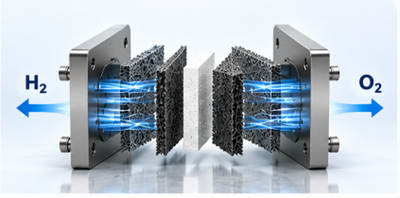
From Electrolysis Cell to Functional System
The development of an efficient electrolyzer does not end with an individual electrolysis cell. Reliable operation also depends on diagnostics, control strategies, temperature and electrolyte management, and the integration of individual cells into larger systems.
Our next development priorities include:
- Advanced electrochemical diagnostics: separately monitoring cathode, anode and ohmic losses, including through reference electrodes.
- Dynamic operation and control: adapting operating conditions to changes in power supply and investigating electrical conditioning and electrode regeneration.
- Electrolyte and gas transport: improving flow fields, gas bubble removal and operating condition monitoring.
- System scale-up: progressing from laboratory cells to larger electrode areas and interconnected cell stacks.
- System integration: connecting electrolyzers with power supplies, balance-of-plant components, hydrogen processing and future users.
Our aim is to combine materials science, electrolysis cell engineering and intelligent control into efficient, durable and flexible hydrogen production technology.
This approach will support the gradual transition from laboratory research to a Slovenian Electrolyzer demonstration system.