

Different Technologies for Different Needs
Several technologies are available for hydrogen production through water electrolysis. Among the most prominent are alkaline water electrolysis (AWE), anion exchange membrane electrolysis (AEM) and proton exchange membrane electrolysis (PEM).
Each technology offers distinct advantages and limitations. They differ primarily in their electrolytes, separators or membranes, electrode materials, cell construction, operating conditions and technological maturity.
The most suitable technology depends on the application, costs, required efficiency, durability and operating profile.
It is important to distinguish electrolysis technology from cell architecture: zero-gap refers to a configuration with minimal electrode spacing and can be implemented across different electrolysis technologies.
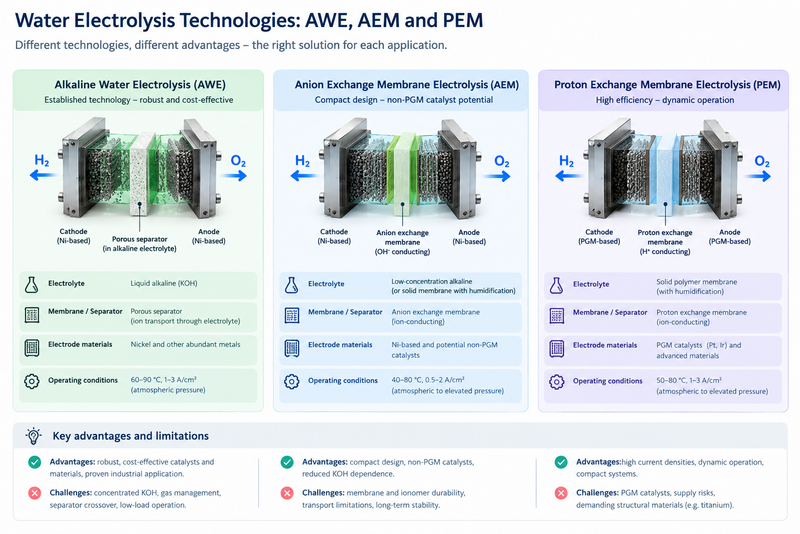
Alkaline Water Electrolysis (AWE)
AWE is an industrially established technology using a liquid alkaline electrolyte and catalysts based on abundant metals such as nickel and iron. A zero-gap configuration reduces the distance between electrodes and can minimise ohmic losses.
Advantages: robust porous separators, cost-effective catalysts and structural materials, and an extensive history of industrial application.
Challenges: handling concentrated KOH, managing gas bubbles, gas crossover through the separator, and operation at low loads.
Anion Exchange Membrane Electrolysis (AEM)
AEM electrolysis uses an anion-conducting membrane and enables a compact cell design. An important advantage is the possibility of using platinum-group-metal-free catalysts, potentially with lower concentrations of alkaline electrolyte.
Advantages: compact cell design, potential use of non-PGM catalysts, and reduced dependence on concentrated KOH.
Challenges: chemical and mechanical durability of the membrane and ionomer, transport limitations, and long-term stability at high current densities.
Proton Exchange Membrane Electrolysis (PEM)
PEM electrolysis is an industrially established technology that enables compact systems, high current densities and rapid response to changes in electrical power input.
Advantages: high current densities, dynamic operation and compact system architecture.
Challenges: dependence on costly and supply-constrained catalyst materials, particularly iridium and platinum, and demanding structural materials, especially titanium on the anode side.
Our Current Development Focus
We consider zero-gap AWE a particularly promising route towards cost-effective electrolysis technology based on readily available materials and nickel electrodes without PGM catalysts.
At the same time, we recognise the advantages of PEM electrolysis at high current densities and under dynamic operating conditions, as well as the development potential of AEM electrolysis, combining membrane-based cell architecture with the possibility of using non-precious-metal catalysts.
Our goal is not to demonstrate that one technology is universally superior. Our goal is to understand, develop and improve electrolysis technologies, selecting the most appropriate solution for each application.
We therefore welcome research and industrial collaborations involving AWE, AEM and PEM electrolysis, spanning materials, electrocatalysts, diagnostics, durability, cell engineering and system integration.