

From Material Composition to the Active Surface
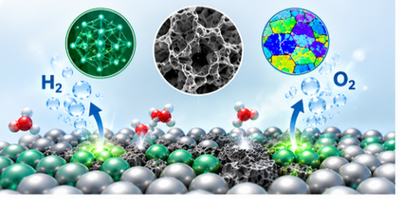
In developing the Slovenian Electrolyzer, we connect materials science with electrocatalysis. Our aim is to understand how chemical composition, crystal structure, microstructure and surface chemistry influence electrode activity and long-term stability.
We focus on nickel-based materials, which enable the development of alkaline water electrolysis cells without platinum-group-metal (PGM) catalysts.
We investigate both the bulk structure of materials and their surface transformations under electrochemical operating conditions. This knowledge provides the basis for developing more active and durable electrodes for the hydrogen evolution reaction (HER) and oxygen evolution reaction (OER).
Our approach: from understanding materials and active sites to designing better electrodes.
PGM-Based HER Catalysts and Advanced Catalyst Supports
In addition to developing precious-metal-free electrocatalysts, we investigate advanced hydrogen evolution reaction (HER) catalysts based on platinum-group metals (PGMs), including platinum (Pt), ruthenium (Ru), and iridium (Ir). Our research focuses on reducing precious-metal loading while improving catalytic activity and long-term stability.
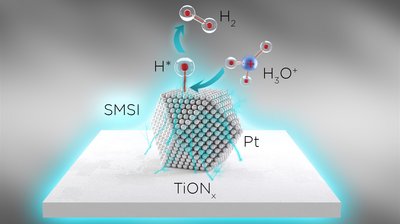
An important part of our research, led by Dr Milutin Smiljanić, involves the development of electrically conductive titanium oxynitride (TiON)-based supports and advanced carbon-based materials. These supports are not merely passive substrates for metal nanoparticles. Through metal–support interactions (MSI), they can influence the electronic structure, catalytic properties, and durability of active sites.
We have demonstrated that TiON-based supports can improve the HER activity and stability of Pt nanoparticles in acidic electrolytes. We have also developed low-loading Ru catalysts supported on TiON–carbon composites that exhibit excellent HER performance in alkaline media, as well as Ru@Ir core–shell nanostructures designed for efficient hydrogen evolution across acidic and alkaline environments.
Our expertise also includes advanced laser-based surface engineering. By using ultrafast laser processing to produce nanostructured, oxygen-deficient titanium oxide (TiO₂₋ₓ) supports, we can control the dispersion of Pt species, ranging from isolated atoms and small clusters to nanoparticles, providing additional opportunities to optimise precious-metal utilisation.
Our approach combines catalyst and support synthesis, advanced electron microscopy, surface characterisation, electrochemical measurements, and theoretical modelling to understand and optimise catalytic activity and stability at the atomic and nanoscale levels.
Our goal is to develop highly active, durable HER catalysts with minimal precious-metal content, contributing to improved performance and resource efficiency across different water electrolysis technologies, including PEM, AEM, and alkaline electrolysis.
Related publications:
- Smiljanić et al., ACS Catalysis12 (2022), 13021–13033.
https://doi.org/10.1021/acscatal.2c03214 - Smiljanić et al., Chemical Engineering Journal517 (2025), 164204.
https://doi.org/10.1016/j.cej.2025.164204 - Popović et al., ACS Catalysis15 (2025), 13444–13457.
https://doi.org/10.1021/acscatal.5c02831 - Smiljanić et al., Chemical Engineering Journal549 (2026), 183188.
https://doi.org/10.1016/j.cej.2026.183188
Cathode – Materials Development for HER
Nickel is one of the key materials for alkaline water electrolysis. However, its electrocatalytic activity and stability depend not only on chemical composition but also on microstructure, surface chemistry, active sites, and structural transformations during electrochemical operation.
Our research combines fundamental understanding of the hydrogen evolution reaction (HER), advanced surface characterisation, and the development of nickel-based electrocatalysts.
We have demonstrated that different nickel surface species play a crucial role in HER activity and stability. While appropriately engineered metallic Ni/Ni(OH)₂ interfaces can promote the reaction, the formation of NiO and subsurface nickel hydrides (NiHₓ) can contribute to catalyst deactivation. Advanced analytical methods, including ToF-SIMS and multivariate analysis, allow us to identify and better understand the surface species associated with catalytic activity.
We also develop advanced nanostructured nickel catalysts by controlling catalyst morphology, particle size, and dispersion to increase the electrochemically accessible surface area and improve nickel utilisation. In collaboration with the University of Ljubljana, we have developed ultrathin nickel-based structures supported on reduced graphene oxide (Ni@rGO), achieving substantially higher HER mass activity than commercial Ni/C catalysts through more efficient nickel utilisation.
An important part of our research is the translation of catalyst materials into practical electrodes for alkaline water electrolysis. In collaboration with international research partners, we have developed Ni–Sn catalytic coatings on porous nickel substrates using electrodeposition and evaluated their performance in zero-gap alkaline electrolysis cells. This approach connects catalyst design, electrode architecture, and performance under practically relevant electrolysis conditions.
We aim to transfer these insights into the development of practical cathodes by combining chemical composition, bulk microstructure, surface engineering, and electrochemical conditioning and regeneration strategies.
Our goal is to develop efficient, cost-effective, and long-lasting precious-metal-free nickel-based cathodes capable of operating at high current densities in alkaline electrolyzers.
Related publications:
- Kozlica et al., Nature Catalysis9 (2026), 1036–1047.
https://doi.org/10.1038/s41929-026-01605-9 - Finšgar et al., Angewandte Chemie International Edition65 (2026), e19929.
https://doi.org/10.1002/anie.202519929 - Mathew et al., Next Materials13 (2026), 103231.
https://doi.org/10.1016/j.nxmate.2026.103231 - Gojgić et al., ACS Applied Energy Materials (2025).
https://doi.org/10.1021/acsaem.4c03140
Research collaborations: National Institute of Chemistry (NIC), University of Ljubljana – Faculty of Chemistry and Chemical Technology (UL FCCT), and international research partners.
Anode – Materials Development for OER
In developing anodes for alkaline water electrolysis, we focus on nickel–iron (NiFe)-based materials, whose electrocatalytic activity and stability strongly depend on their chemical composition, microstructure, and surface transformations during the oxygen evolution reaction (OER).
Our research combines the development of NiFe (oxy)hydroxide catalytic layers, metallurgy, and advanced surface engineering. We have demonstrated that laser processing of commercially available nickel-based alloys enables controlled modification of their surface structure and improved electrocatalytic activity. During electrochemical operation, further surface transformations occur, including the formation of active nickel (oxy)hydroxide layers and the redistribution of individual elements.
This approach enables the development of catalytically active surfaces directly on readily available metallic materials and opens opportunities to optimise both the bulk microstructure and surface chemistry of electrode materials.
Our goal is to integrate metallurgy, materials science, and electrocatalysis to develop efficient, long-lasting, precious-metal-free anodes capable of operating at practically relevant current densities.
Related publications:
- Surca et al., International Journal of Hydrogen Energy205 (2026), 153321.
https://doi.org/10.1016/j.ijhydene.2025.153321 - Journal of Catalysis (2026).
https://www.sciencedirect.com/science/article/abs/pii/S0021951726005336
From Microstructure to Active and Stable Electrodes
In the next stage of catalyst development, we aim to optimise not only chemical composition but also the microstructure and surface properties of electrode materials.
Our approach focuses on three interconnected levels:
- Material composition and structure: nickel-based alloys, phase composition, crystallographic orientation and defects.
- Microstructure: grain size and orientation, grain boundaries, dislocations, deformation, and the effects of mechanical and thermal processing.
- Surface chemistry: active sites, oxide and hydroxide species, impurity effects and surface transformations during electrolysis.
Using advanced techniques such as SEM/EBSD, identical-location electron microscopy, local electrochemistry and surface analysis, we connect changes in material structure with electrochemical performance.
Our goal is to identify microstructures and surface states that combine high catalytic activity with long-term stability, and to apply this knowledge to the development of improved electrodes for the Slovenian Electrolyzer.
Microstructure as a Tool for Catalyst Design
In collaboration with the Institute of Metals and Technology (IMT), we investigate how the microstructure of metallic materials influences their electrocatalytic behaviour.
In our joint study of a nickel-based superalloy, we demonstrated that crystallographic orientation and grain size influence the development of electrocatalytically active surfaces during the oxygen evolution reaction (OER). By combining identical-location electron microscopy, electron backscatter diffraction (EBSD) and local electrochemical measurements using scanning electrochemical cell microscopy (SECCM), we linked the microstructure of individual grains to their surface transformations and electrocatalytic activity.
This opens an additional direction for catalyst development: optimising not only chemical composition, but also deliberately engineering the microstructure of electrode materials.
We aim to apply this approach to the development of more active and durable electrodes for the Slovenian Electrolyzer.
Related publication:
Donik et al., Chemical Communications61 (2025), 14097–14100.
https://doi.org/10.1039/D5CC02703A